
We are committed to food packaging PVC cling film, PE cling film,stretch wrap, aluminum foil and other disposal food packing film/foil.

Language
>
We are committed to food packaging PVC cling film, PE cling film,stretch wrap, aluminum foil and other disposal food packing film/foil.
Private label cling film is one of the easier products to put your own name on — the film itself is proven, the formats are standard, and the barrier to entry is far lower than for most consumer goods. What goes wrong on a first order is rarely the film. It is the labelling rules, the food-contact paperwork and the pack format decisions that were never settled before the order was placed.
This guide is written for importers, distributors and retail buyers preparing a first private label cling film order. It covers the seven things to settle before you approach a private label cling film manufacturer: material, pack format, market labelling, food-contact documents, samples, logistics and the commercial terms. Artwork files, MOQ calculation and production lead time are covered separately in our custom printed cling film guide — read that one first if you have not chosen your print specification yet.
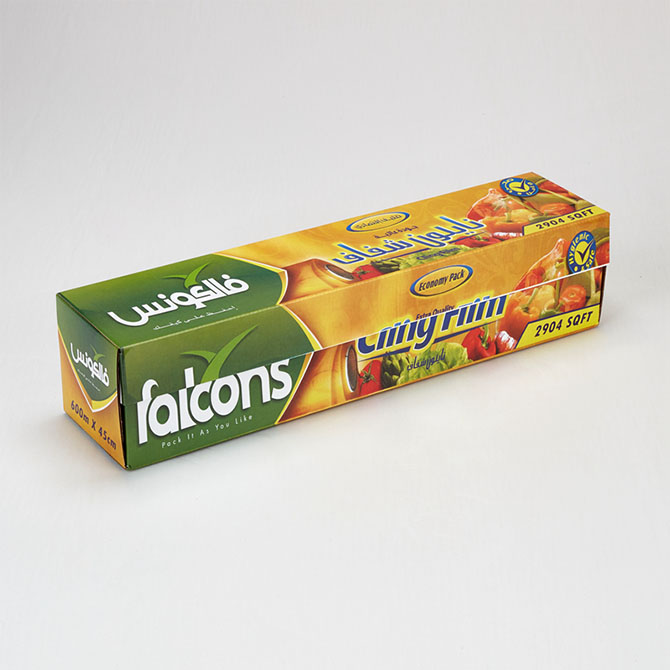
On a cling film order, "private label" can describe three quite different products. Suppliers quote very differently for each, so it is worth being precise about which one you are asking for.
| Format | What carries your brand | Typical buyer |
|---|---|---|
| Printed colour box | Full-colour carton with your artwork | Supermarket and retail chains |
| Labelled roll | Printed label wrapped around the roll | Cash-and-carry, wholesalers |
| Bulk jumbo roll | Printed outer carton and pallet label | Catering suppliers, repackers |
A fully printed colour box is a separate print job from the film, so it carries its own setup cost and its own minimum. A labelled bulk roll avoids that entirely and is the usual starting point for a first order. If your volumes are still modest, ask your supplier whether a labelled jumbo roll can be upgraded to a printed box later without changing the film specification.
Almost every private label cling film sold at retail is PVC or PE. Both are food-grade when produced correctly, and both are available as OEM Cling Film under your own brand. The choice is usually driven by the market and the end user rather than by price alone.
| Property | PVC Cling Film | PE Cling Film |
|---|---|---|
| Cling | Very strong, self-adhering | Moderate, needs tension |
| Clarity | High, glass-clear | Slightly hazy |
| Handling | Thin, can tear if pulled fast | Softer, easier to tear by hand |
| Common retail use | Foodservice, professional kitchens | Household retail packs |
| Recycling perception | Lower, PVC is harder to recycle | Higher, PE is widely collected |
If your market is sensitive to plastic-type messaging — much of the EU and Australasia is — PE is the safer default for a household retail pack. PVC remains the standard for catering and foodservice because nothing else clings as reliably to a wet bowl. Both are produced in the same 8–23 micron thickness range, 0–100 cm roll widths and 0–2000 m roll lengths, so switching material does not force you to change your pack dimensions.
Pack format is a retail decision, not a production one, but it has to be made before the supplier can quote. Four variables define the pack, and all four are set by where the product will sit on a shelf or in a storeroom.
A practical route is to buy one competing product from the market you are targeting, measure it, and send those dimensions to the supplier as your starting specification. Custom cling film packaging is expensive to reverse once the carton has been printed, so it is worth settling these four decisions before artwork begins. It removes weeks of back-and-forth and gives the factory something concrete to price. Our PVC cling film with colour box and PE cling film ranges are both produced to customer dimensions on this basis.
This is where first orders most often stall. Cling film that touches food is a food-contact material, and food-contact materials carry their own labelling obligations on top of ordinary consumer-pack rules. Cling film labelling requirements differ by market, but four items appear almost everywhere.
Ask your supplier which of these they will print for you and which are your responsibility as the brand owner. Many factories will lay out the mandatory panels from your text, but the accuracy of that text remains the importer's obligation. Getting the wording agreed at artwork stage is far cheaper than reprinting a container.
A food contact certificate for cling film — and the cling film declaration of compliance that sits alongside it — is the document set your own customers, auditors or customs may ask to see. Request it before you order, not after — and check that the certificate names the material you are actually buying, not a different film from the same factory.
| Document | What it covers |
|---|---|
| Declaration of compliance | Written confirmation the material meets food-contact rules for its intended use |
| Migration test report | Laboratory results for overall and specific migration limits |
| Food-contact certificate | Third-party certification such as LFGB or an equivalent food-grade approval |
| Material safety data sheet | Composition and handling information, often requested by freight forwarders |
Our films are supplied with EU and LFGB food-grade certification, and we can provide the declaration of compliance alongside the shipping documents on request. If your market requires an additional local approval, tell the supplier at quotation stage so it can be built into the schedule rather than discovered at the port.
A first private label order should always start with a physical sample. Photographs do not show cling performance, tear behaviour or how a film behaves on the dispenser your customer will actually use.
Keep the signed pre-production sample. It is the reference if a later shipment is questioned, and it is the document that makes a claim enforceable. Ask for the sample to be sent by courier with a tracking number so the approval date is on record.
A first enquiry that arrives with the following information usually gets a firm price in a single reply. A first enquiry that asks "how much is your cling film" gets a range that is useless for budgeting.
With those seven answers a private label cling film supplier can quote film, packaging and freight separately, which makes it easy to see where the cost actually sits. It also makes it obvious whether the supplier has handled your market before.
There is no single figure. A labelled bulk roll has a much lower entry point than a fully printed colour box, because the box is a separate print job with its own setup. Ask for the minimum at your specific specification rather than for a general number.
Yes. Send vector artwork with fonts converted to outlines, in CMYK, with bleed and a vector barcode. If you do not have print-ready files, ask whether the factory offers artwork support before hiring a designer.
No. The certification belongs to the material and is held by the factory. As the brand owner you need to obtain and keep the declaration of compliance and test reports for the film you are selling, and make sure the certificate matches the material supplied.
It depends on the pack format and on how quickly artwork and samples are approved. Bulk labelled rolls move fastest; printed boxes add a print and proof stage. Build the sample approval time into your launch plan rather than treating it as an afterthought.
A first private label cling film order is a sequence of approvals, not a single purchase. Settle the material and pack format first, confirm the labelling rules for your market, collect the food-contact documents, and approve a physical sample before committing to a print run. Do those four things and the order runs on schedule; skip them and the delays almost always land at the point where money has already been spent.
If you are preparing a first order, send us your target market, pack dimensions and required documents. We will come back with a film specification, the packaging options that fit it, and a quotation that separates product from freight.

We focus on overseas markets and major exports to different countries, selling well in Europe, America, the Middle East, Southeast Asia, etc.
Contact
No. 242 Shangjia Fenxi Road,Wanjiang District, Dongguan city, Guangdong Province ,China
Email:
Phone:
+86 18938161161