
We are committed to food packaging PVC cling film, PE cling film,stretch wrap, aluminum foil and other disposal food packing film/foil.

Language
>
We are committed to food packaging PVC cling film, PE cling film,stretch wrap, aluminum foil and other disposal food packing film/foil.
Pallet stretch wrap is bought on price far more often than it is bought on performance, and the cost of that shows up later — as shifted loads, torn film on arrival, and claims that are almost impossible to win because nobody recorded what film was used. Load stability is not a property of the film alone. It is the result of a film specification matched to a specific load, applied with the right wrap pattern and the right amount of stretch.
This guide sets out the stretch wrap film specs that actually control whether a pallet survives a container journey, and how to specify them for export packing rather than for a warehouse floor. If you have not yet chosen between hand-applied and machine-applied film, start with our comparison of hand stretch film vs machine stretch film and come back to this page for the specification detail.
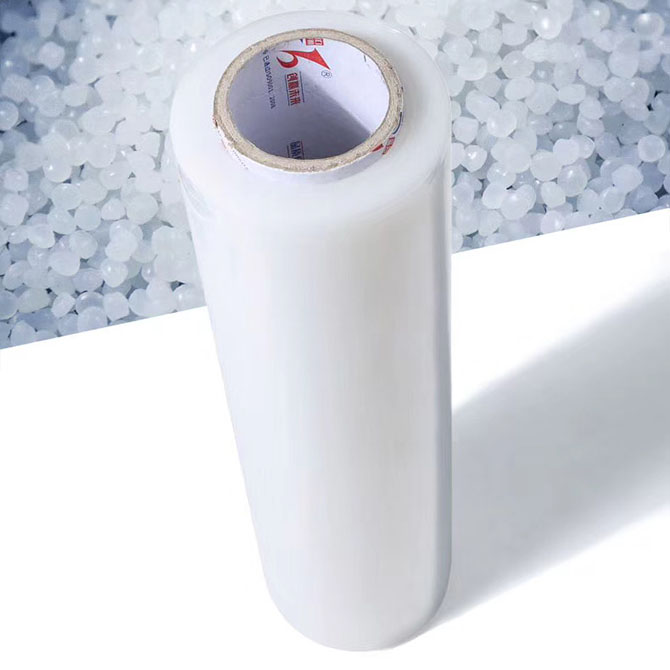
A pallet stays together because the film holds the load under continuous tension. That tension is produced by stretching the film as it is applied, and it is maintained by the film's elastic recovery — the film's tendency to pull back towards its original length after being stretched. Four factors decide how well that works.
| Factor | What it controls | Set by |
|---|---|---|
| Film thickness | Puncture resistance and holding force per layer | Film specification |
| Pre-stretch | How much tension is stored in the film | Machine setting or operator technique |
| Wrap pattern | Coverage of corners, base and top | Wrapping programme |
| Containment force | The resulting pressure holding the load | The three above combined |
The practical point is that thickness alone does not make a load stable. A heavier gauge applied with too little pre-stretch can hold less securely than a lighter gauge applied correctly. Conversely, a film stretched beyond its elastic limit will relax, and the load will loosen in transit no matter how many layers are applied.
Five specification lines appear on every stretch film quotation. Knowing what each one does tells you which to negotiate and which to leave alone.
Machine Stretch Film thickness is normally quoted in microns. Our films are produced across an 8–23 micron range. Thin film gives more metres per kilogram, which lowers cost per pallet; thicker film resists punctures from sharp corners and irregular loads. For a uniform load of cartons, a mid-range gauge applied at high pre-stretch is usually the most economical answer. For pallets with protruding edges, brick packs or metal components, step up the gauge rather than adding layers.
Stretch film gauge and width work together. A narrow roll concentrates force but needs more revolutions to cover the load; a wider roll covers faster but wraps around irregularities less tightly. Our rolls are supplied from 5 cm to 100 cm wide, which covers everything from small hand rolls to full-width machine film. Match the width to your pallet height and to the number of wraps your programme is designed to apply.
Length runs from 5 m to 2000 m. Longer rolls mean fewer roll changes and less downtime on an automated line, but a heavier roll to lift on a manual one. Core diameter has to match the machine's chuck — this is a common cause of a first order being unusable, so confirm the core size against the wrapper manual before ordering.
Modern wrappers pre-stretch film before it reaches the load, typically in the region of 150% to 250%. Higher pre-stretch uses less film per pallet and increases holding force, up to the point where the film starts to whiten or tear. Ask the machine manufacturer for the film's maximum recommended pre-stretch, and ask your film supplier to confirm the film is specified for that ratio rather than for hand application.
Machine film usually carries cling on one side only, so the film bonds to itself as layers overlap without sticking to the machine rollers. If your line jams or the film blocks on the roll, the cling configuration is the first thing to check.
Pallet wrap containment force is the pressure the film exerts on the load once wrapping is complete. It is the number that correlates most closely with whether a pallet arrives intact, and it is the number almost nobody records.
It is measured with a force gauge: the probe is pushed against the side of the wrapped pallet and the force needed to deflect the film is read off. Take readings at several heights and on more than one face, because corners and the top layer behave differently from the middle of a flat side. Record the readings, the film specification, the pre-stretch setting and the wrap pattern together — that combination is your packaging standard, and without it a damage claim has no baseline.
If you do not have a gauge, the practical substitute is to film a trial pallet, transport it over a realistic route, and inspect it on arrival. It is cruder, but it still produces a written record, which is more than most exporters have.
Stretch film for export packing has to survive conditions a domestic pallet never sees. Three differences matter, and each one argues for a specification slightly stronger than the warehouse version.
Humidity is a further consideration for hygroscopic goods, though here the film is doing a secondary job: it keeps moisture out as much as it keeps the load together. If your product is moisture-sensitive, say so when specifying — it changes how much of the pallet needs covering, including the top.
The choice is decided by pallet volume, not by film price. Hand-applied rolls need no machinery and suit low volumes, irregular loads and sites where a wrapper is impractical. Machine film needs a wrapper but produces consistent, repeatable containment force and uses less film per pallet once volumes justify the equipment.
A useful rule of thumb: if more than a handful of pallets a day leave your site, the film saving from machine pre-stretch usually repays the wrapper. Below that, a stretch film hand roll is the more sensible specification. Our machine pallet wrap film is produced from LLDPE in the same thickness and width ranges as the hand rolls, so a move between the two does not force you to re-engineer the load.
A stretch film roll for palletising is quoted against whatever information you provide. Send all of the following and the quotation will be usable; omit them and you will be comparing prices for different products.
| Item to specify | Why it matters |
|---|---|
| Thickness in microns | Sets strength, puncture resistance and cost per pallet |
| Width | Must suit your pallet height and wrapping programme |
| Length per roll | Drives roll changes and handling weight |
| Core diameter | Must match the machine chuck |
| Hand or machine grade | Determines cling configuration and stretch performance |
| Carton count | 2, 6 or 12 rolls per carton — sets your outer case and pallet count |
| Load type and weight | Lets the supplier recommend a gauge instead of guessing |
Our stretch films are cast from PE and supplied with EU and LFGB certification, packed in standard export cartons and shipped from Shenzhen or Guangzhou. Tell us the load and the route and we will quote the specification that fits it, rather than the specification that happens to be in stock.
It depends on the load rather than the destination. Uniform cartons on a stable pallet can use a thinner gauge at high pre-stretch; sharp, heavy or irregular loads need a heavier gauge to resist punctures. Tell the supplier what you are wrapping and the route, and specify from there.
Layer count is the wrong way to think about it, because two layers at low tension hold less than one at high tension. Set the containment force you need, then adjust layers and pre-stretch together until the gauge readings reach it.
Generally no. Hand rolls are not designed for the pre-stretch a wrapper applies, so they tend to tear or whiten and the result is worse than wrapping by hand. Specify machine grade film for a machine.
Only if the film comes into direct contact with food, or if the pallet is being wrapped in a food production area where cross-contamination rules apply. Otherwise a standard industrial grade is sufficient, and it will be cheaper.
Load stability stretch film works when the gauge, width, pre-stretch and wrap pattern are chosen together for a specific load. Thickness on its own tells you very little. The exporters who get this right are the ones who record their film specification and their containment force readings, then hold both constant — so that when a pallet does arrive damaged, they can tell whether the film changed or the load did.
Send us the pallet dimensions, load weight, route and machine details. We will come back with a film specification and the carton and pallet configuration to go with it.

We focus on overseas markets and major exports to different countries, selling well in Europe, America, the Middle East, Southeast Asia, etc.
Contact
No. 242 Shangjia Fenxi Road,Wanjiang District, Dongguan city, Guangdong Province ,China
Email:
Phone:
+86 18938161161