
We are committed to food packaging PVC cling film, PE cling film,stretch wrap, aluminum foil and other disposal food packing film/foil.

Language
>
We are committed to food packaging PVC cling film, PE cling film,stretch wrap, aluminum foil and other disposal food packing film/foil.
Two cling film quotations can carry the same cling film price per roll and still deliver very different value, because the price of a roll tells you nothing about how many metres are wound onto it or how much material each metre contains. The two figures that make a quotation comparable are thickness, quoted in microns, and roll length. Line those up and you are pricing the same product; leave them out and you are comparing two different ones.
This cling film thickness guide covers what the micron figure actually controls, how it drives cling film cost per metre, and how to specify thickness and roll length together for catering, retail and jumbo roll supply. If you already know the format you need, our catering film wrap and PVC cling film jumbo roll pages show the widths and carton counts we produce.
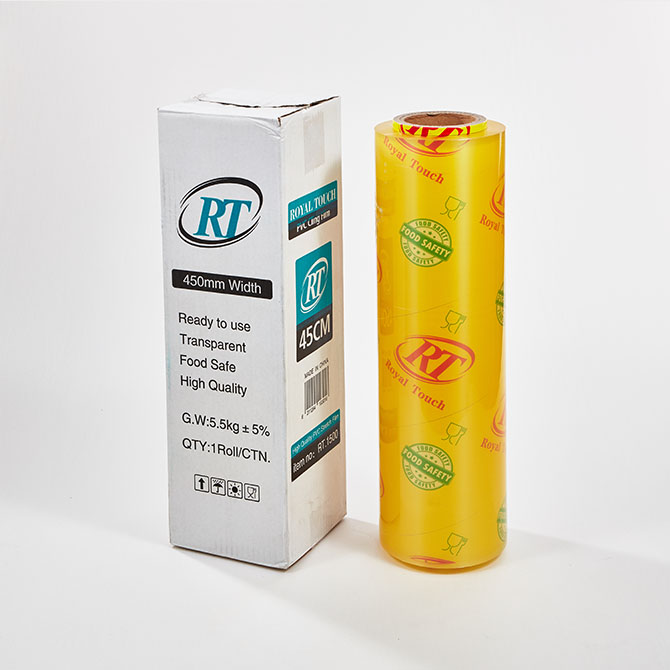
Cling film thickness is measured in microns, where one micron is one thousandth of a millimetre. Our PVC Cling Film is cast across a range of 8 to 23 microns, and the PE range sits inside the same window. For a sense of scale, a sheet of office paper measures roughly 100 microns, so even the heaviest film on this list is about a tenth of that.
The cling film micron figure matters because it sets four properties at once: tensile strength, puncture resistance, cling, and the number of metres you get out of a kilogram of resin. A 10 micron film and a 20 micron film drawn from the same resin differ by roughly a factor of two in material consumed per square metre. That difference, not the headline roll price, is what eventually shows up in your packaging budget.
Production method matters too. Cast film is cooled against a chilled roller, which produces high clarity and a consistent gauge across the full web width. That is why pvc cling film thickness is normally quoted as a band rather than a single figure, and why a serious specification asks for the tolerance as well as the nominal value. A film quoted at 12 micron with a tight tolerance behaves more predictably on a wrapping line than one quoted at 12 micron with a wide one.
Cling film cost per metre comes from two numbers: the price of the roll and the number of metres on it. Divide one by the other and you have a figure that can be compared across suppliers, formats and thicknesses. It is the single most useful line on a specification sheet, and it is the one most often missing from quotations.
The relationship is not linear in the direction buyers expect. Halving the thickness roughly doubles the metres per kilogram, so a thinner film usually wins on cost per metre. But it loses on puncture resistance, on cling under tension, and on how many layers you need for the same job. The cheapest film per metre is not automatically the cheapest film per wrapped item.
| Thickness band | Relative metres per kg | Where it usually fits |
|---|---|---|
| 8–10 micron | Highest | Light wrapping, high-volume kitchen use, cost-led tenders |
| 11–14 micron | High | Everyday catering and retail, the most common specification |
| 15–18 micron | Medium | Heavier items, cold rooms, repeated handling |
| 19–23 micron | Lowest | Sharp or irregular items, jumbo roll converting, premium retail |
The bands overlap in practice, and the right answer depends on what is being wrapped. A film at the light end applied to a tray with sharp corners will fail and be replaced mid-shift, which erases the saving in a single afternoon.
Cling film roll length is the second half of the comparison, and it is where quotations most often stop being comparable. Our rolls run from a few metres on a retail carton up to 2000 metres on a jumbo roll. Two rolls of identical thickness and identical price can differ by several hundred metres, which changes cost per metre by a wide margin.
Longer rolls reduce the number of roll changes and the associated downtime, which matters most on a busy line where an operator is stopping every few minutes. They also weigh more, which matters on manual dispensers and in retail packs where the customer is lifting the box off a shelf. Roll size is therefore a function of who is handling the film, not only of the price.
Roll width belongs in the same conversation. A wider roll covers a tray in fewer passes; a narrower roll reaches into smaller containers and wastes less film on the edges. Because width multiplies into the same cost calculation, a quotation that omits width is incomplete even when thickness and length are correct. Our big roll of cling film range is supplied from 0 to 100 cm wide so that width can be matched to the container rather than to whatever is on the shelf.
Thin film fails in three predictable ways, and each one carries a cost that never appears on the quotation.
The practical test is to compare cost per wrapped item, not cost per metre. Wrap a representative sample with the candidate film, count the film consumed, and multiply by the cost per metre. That number is the one worth negotiating.
Cling film is specified against the item being wrapped and the conditions it is stored in, not against a single industry standard. The table below maps common applications to a starting thickness, which is a point to test rather than a final answer.
| Application | Starting thickness | What drives the choice |
|---|---|---|
| Professional kitchens and catering | 10–14 micron | High daily volume, bowls and trays with smooth rims |
| Supermarket fresh counters | 12–15 micron | Clarity and cling for presentation, plus repeated opening |
| Retail boxed film | 10–12 micron | Dispenser compatibility and a roll length the shopper can handle |
| Cold rooms and freezer storage | 15–18 micron | Lower temperature reduces cling, so a heavier gauge recovers it |
| Jumbo rolls for converting | 8–23 micron | Downstream slitting, printing and rewinding requirements |
Cold storage is worth a note of its own. Cling depends partly on the film staying soft enough to conform to the surface underneath. As temperature falls, the film stiffens and grip drops, so a specification that works perfectly at ambient temperature can feel weak in a chiller. Buying a heavier gauge is one answer; buying a film formulated for low temperature is usually the better one, and it is a question worth asking before the order rather than after.
A quotation can only be compared if it carries the same fields on both sides. Ask for all of the following, and treat any that are missing as a reason to go back rather than to assume.
| Item to confirm | Why it changes the answer |
|---|---|
| Thickness in microns, with tolerance | Sets metres per kg and therefore cost per metre |
| Roll length in metres | The denominator of the cost per metre calculation |
| Roll width in centimetres | Determines coverage per pass and film wasted at the edges |
| Net weight per roll | Lets you cross-check the thickness and length claims against each other |
| Rolls per carton | Drives your outer case, pallet count and freight cost |
| Core diameter | Must match the dispenser or machine chuck you already own |
| Food-contact certificate | Required for any film that touches food; see our guide to food contact compliance |
Send the list with your enquiry and the reply becomes a specification you can hold a supplier to. Send only a target price and you will receive film built to a price, which is rarely the film you wanted.
There is no single standard, but 11 to 14 micron covers the majority of catering and retail orders because it balances film consumption against handling. Anything below 10 micron is bought deliberately for cost or for high-volume kitchen use, and anything above 18 micron is bought for a specific problem such as sharp items or cold storage.
Thicker film resists punctures better, but strength is not only about gauge. Resin grade, cast consistency and cling formulation all contribute, and a well-made 12 micron film can outperform a poorly made 15 micron one on a wrapping line. Compare samples on your own product rather than on the micron figure alone.
It varies by format. Retail cartons typically carry a short roll measured in tens of metres, catering rolls run to a few hundred, and jumbo rolls go up to 2000 metres. Because length is the denominator in the cost per metre calculation, it should always be stated explicitly on a quotation rather than left to be inferred from the roll diameter.
Thickness itself does not determine food safety; the material and its certification do. Film that carries EU and LFGB food-contact certification is suitable for direct food contact at the thickness it is certified for. Thickness affects performance and cost, not compliance, which is why the two questions should be asked separately.
Cling film roll size, thickness and price only mean something together. A roll price is a starting point; cost per metre turns it into a comparable figure; and cost per wrapped item is the number that actually reflects your operation. Buyers who specify all three stop negotiating on a headline price and start negotiating on a specification, which is a far better position to be in.
Tell us what you are wrapping, how it is stored and how the film will be applied. We will come back with a thickness, a roll length and a width that fit the job, along with the cost per metre so you can check it against your current supply.

We focus on overseas markets and major exports to different countries, selling well in Europe, America, the Middle East, Southeast Asia, etc.
Contact
No. 242 Shangjia Fenxi Road,Wanjiang District, Dongguan city, Guangdong Province ,China
Email:
Phone:
+86 18938161161