
We are committed to food packaging PVC cling film, PE cling film,stretch wrap, aluminum foil and other disposal food packing film/foil.

Language
>
We are committed to food packaging PVC cling film, PE cling film,stretch wrap, aluminum foil and other disposal food packing film/foil.
Heat resistant cling film is manufactured using polymer materials selected for their flexibility, transparency, food-contact suitability, and thermal performance. Common materials include polyethylene (PE), polyvinyl chloride (PVC), and specialized polymers used in multilayer or high-temperature packaging films.
The choice of material directly affects how the film performs during food storage, wrapping, heating, and transportation. Manufacturers must consider both the required temperature resistance and the specific food packaging application.
Different polymers offer different advantages in cling film production.
Polyethylene (PE)
PE is widely used in food packaging because of its flexibility, moisture resistance, and suitability for many food-contact applications.
Common PE types include:
LDPE (Low-Density Polyethylene)
LLDPE (Linear Low-Density Polyethylene)
These materials are commonly used in Food Wrapping films. Their heat resistance depends on the polymer grade, formulation, and film structure. Standard PE Cling Film is not necessarily suitable for high-temperature applications.
Polyvinyl Chloride (PVC)
PVC is another common material used in cling film manufacturing. It provides good transparency, flexibility, and cling properties, making it suitable for wrapping fresh food and other packaging applications.
However, PVC formulations may contain plasticizers and other additives. Their suitability for heating and food contact depends on the specific formulation and applicable regulations.
Specialized Heat-Resistant Polymers
Certain high-performance polymers can be used in specialized food packaging films where higher thermal resistance is required.
Depending on the application, these may include polypropylene (PP), polyethylene terephthalate (PET), or other engineered polymer structures. These materials are not all conventional cling film materials, and their suitability depends on the final film design.
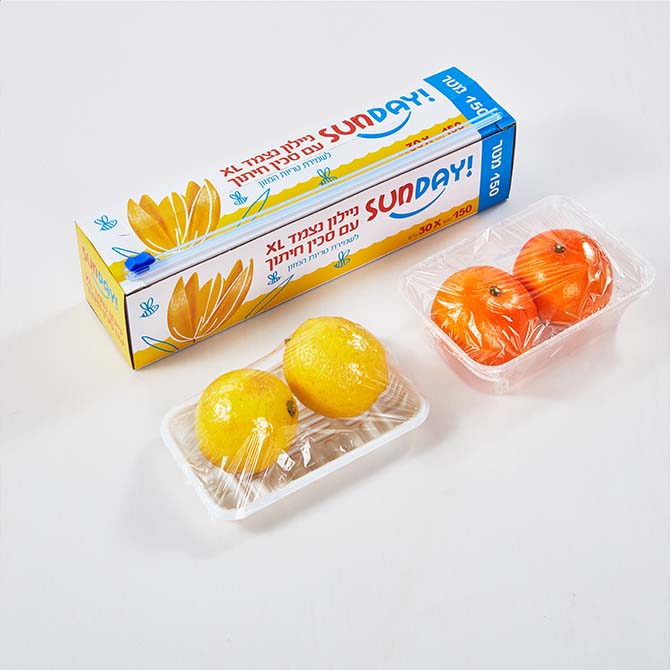
Material selection influences several important physical and functional properties.
| Material | Main Characteristics | Common Packaging Uses |
|---|---|---|
| PE | Flexible, moisture-resistant | Food wrapping and storage |
| PVC | Transparent, flexible, good cling | Fresh food wrapping |
| PP | Good heat resistance compared with many common packaging plastics | Heat-resistant packaging films |
| PET | Good mechanical strength and dimensional stability | Specialty and multilayer packaging |
For example, PE films are often selected for everyday food wrapping because of their flexibility and moisture barrier properties. PP-based films may be considered when higher-temperature performance is required.
However, material type alone does not determine the maximum usable temperature. Film thickness, additives, processing methods, and product structure also matter.
In addition to the base polymer, manufacturers may use selected additives to improve film performance.
Plasticizers
Plasticizers are used in certain PVC formulations to improve flexibility and handling characteristics. Their type and concentration must comply with applicable food-contact regulations.
Antioxidants
Antioxidants help reduce polymer degradation caused by heat and oxidation during processing and use.
Slip Agents
Slip agents can reduce friction between film surfaces, improving unwinding and handling during packaging operations.
Anti-Blocking Agents
These additives help prevent adjacent film layers from sticking together excessively during storage and handling.
Not every cling film contains all these additives. The formulation depends on the base material, manufacturing technology, and intended application.
The manufacturing process influences the film's thickness, uniformity, and final performance.
A typical production process includes:
Raw Material Selection: Choose suitable polymer grades and additives according to the product specifications.
Material Mixing: Blend the raw materials to achieve the required formulation.
Film Extrusion: Melt and process the polymer through an extrusion system to form a continuous film.
Cooling and Thickness Control: Cool the film and maintain consistent thickness throughout production.
Slitting and Rewinding: Cut the film into the required widths and roll formats.
Quality Inspection: Check thickness, transparency, tensile properties, appearance, and other application-specific requirements.
For specialized heat-resistant products, additional testing should verify thermal performance under the intended food-contact conditions.
Material selection should be based on the intended packaging environment rather than heat resistance alone.
For Fresh Food Storage: PE and PVC films may be considered depending on food-contact requirements and desired cling properties.
For Microwave Applications: Select a film specifically tested and labeled for microwave use.
For Higher-Temperature Packaging: Evaluate PP-based or other specialized film structures against the required temperature and exposure duration.
For Commercial Food Packaging: Consider transparency, mechanical strength, processing stability, and applicable food-contact regulations.
Manufacturers should also conduct thermal testing and food-contact migration assessments where required to verify product suitability.
Heat resistant cling film can be manufactured using PE, PVC, PP, and other specialized polymer materials, depending on the required packaging performance. PE and PVC are commonly used for conventional food wrapping, while PP and engineered multilayer structures may be considered for selected higher-temperature applications.
For manufacturers, choosing the right material involves balancing heat resistance, flexibility, transparency, food safety, and production requirements. Proper material selection and performance testing help ensure that the finished film is suitable for its intended use.
Previous: No
Next: What Temperature Can Heat Resistant Cling Film Withstand?

We focus on overseas markets and major exports to different countries, selling well in Europe, America, the Middle East, Southeast Asia, etc.
Contact
No. 242 Shangjia Fenxi Road,Wanjiang District, Dongguan city, Guangdong Province ,China
Email:
Phone:
+86 18938161161