
We are committed to food packaging PVC cling film, PE cling film,stretch wrap, aluminum foil and other disposal food packing film/foil.

Language
>
We are committed to food packaging PVC cling film, PE cling film,stretch wrap, aluminum foil and other disposal food packing film/foil.
Extreme temperature does not automatically make cling film toxic, but it can change its mechanical properties and may affect the migration of certain film components into food. The actual risk depends on the polymer, additives, food composition, contact temperature, contact time, and the film's approved conditions of use. For this reason, professional food packaging should be evaluated through migration testing and applicable food-contact regulations, rather than assuming that all plastic wrap behaves the same under heat or cold. The EU plastics regulation, for example, uses specific migration limits and an overall migration limit for plastic food-contact materials, with testing based on foreseeable worst-case conditions.
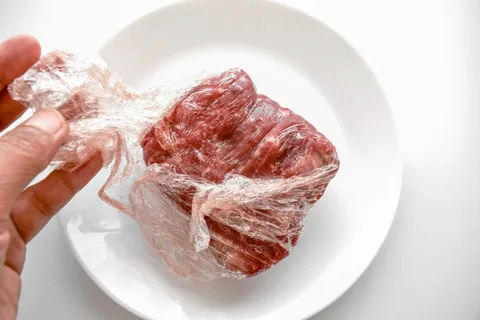
Low temperatures generally have a stronger effect on the physical properties of a film than on the formation of new toxic substances.
As temperature decreases, some polymer films can become less flexible and more susceptible to stress during stretching, folding, or impact. This can affect handling performance, especially when a film is removed directly from refrigerated or frozen storage.
For food packaging applications, it is therefore important to distinguish between:
Chemical stability — whether the film's components remain stable under the intended conditions.
Mechanical stability — whether the film retains sufficient flexibility, tensile strength, and resistance to tearing.
A film that remains chemically compliant may still become less suitable for a particular wrapping process if its mechanical properties change significantly at low temperatures.
Research on PVC Food Films has also demonstrated that migration behavior is affected by temperature, food composition, and the specific plasticizer formulation.
Freezing conditions are different from heating because the main challenge is often film flexibility and package integrity rather than thermal degradation.
During freezing, the film may become stiffer, while the packaged food can expand or contract. Repeated temperature changes can also place additional mechanical stress on the film.
For commercial applications, the film specification should therefore identify whether the product is intended for refrigerated or frozen food, rather than assuming that a general-purpose cling film is suitable for every temperature range.
For more information about temperature-related performance, see Is Cling Film Heat Resistant?.
Heat can affect polymers in several ways.
Depending on the specific material and temperature, heating can cause the film to soften, shrink, lose dimensional stability, or change its mechanical properties. At sufficiently high temperatures, degradation reactions can also occur.
However, it is inaccurate to conclude that “heated plastic wrap automatically produces toxic substances.”
Food-contact safety depends on the specific formulation and intended conditions of use. A compliant food-contact film is manufactured and tested for defined applications. The important question is whether the actual use remains within those conditions.
This is particularly important for applications involving hot food, microwave use, oven heating, or direct contact with heated fatty foods.
Migration refers to the transfer of substances from the food-contact material into food or a food simulant.
Temperature is one of the variables that can influence migration because molecular mobility and diffusion generally increase as temperature rises. However, migration is not controlled by temperature alone.
Other important variables include:
Contact time
Food or food-simulant composition
Polymer type
Additive chemistry
Film thickness
Surface-to-food ratio
Temperature history
European food-contact rules explicitly require migration assessment under standardized conditions representing the intended or foreseeable worst-case use. The regulation establishes both specific migration limits (SMLs) for individual substances and an overall migration limit (OML) for plastics.
This is an especially important consideration for some PVC-based films.
Certain additives used in flexible PVC can have greater affinity for fatty foods or oily food simulants. Studies of PVC cling films have shown that plasticizer migration can vary substantially according to formulation and the type of food in contact with the film.
This means that the statement “food-grade plastic wrap is safe for every food under every condition” is too broad.
Instead, a professional assessment should consider:
Film formulation + Food type + Temperature + Contact time + Intended application
Fatty foods, acidic foods, aqueous foods, and dry foods can interact differently with a packaging film.
The answer requires a distinction between migration and degradation.
A component already present in the film moves from the film into the food. This can occur even when the polymer itself has not chemically decomposed.
At sufficiently high temperatures, a polymer or additive may undergo chemical decomposition and generate degradation products.
These are different mechanisms and should not be treated as the same phenomenon.
For normal food-packaging use within a film's specified temperature range, the relevant safety question is generally whether the material complies with the applicable food-contact requirements under its intended conditions of use. FDA guidance similarly evaluates food-contact substances based on their regulatory status and the substances reasonably expected to migrate under their intended use.
PVC cling film can provide useful transparency, flexibility, and cling performance, but its formulation is particularly important because flexible PVC commonly relies on additives to achieve the required mechanical properties.
Different plasticizers and formulations can produce different migration behavior. Research comparing PVC cling-film formulations has shown that migration varies with the chemistry of the plasticizer and the food-simulant environment.
For this reason, commercial buyers should not evaluate PVC cling film solely by the term PVC. They should also examine the technical specification, food-contact compliance, intended food types, and recommended temperature conditions.
See PVC Cling Film for Food Packaging for a product-oriented example.
PE Cling Films have their own temperature-performance characteristics and should also be evaluated according to their formulation and intended application.
PE belongs to the polyolefin family, and FDA food-contact guidance specifically identifies polyolefins under the applicable provisions of 21 CFR 177.1520 when the relevant requirements are met.
This does not mean every PE film is suitable for every food or temperature condition. Compliance is determined by the particular material, formulation, manufacturing process, and conditions of use.
More background is available in What Is PE Cling Film?.
For professional food packaging, safety should be demonstrated through documentation and testing, not simply through visual inspection.
A suitable evaluation can include:
This determines the total amount of substances transferred from the plastic into an appropriate food simulant under specified conditions.
This evaluates individual substances for which regulatory limits apply.
Different simulants can represent aqueous, acidic, alcoholic, or fatty food conditions. FDA guidance, for example, recommends different simulants for different polymer and food-contact scenarios.
Testing should represent the intended or reasonably foreseeable worst-case contact conditions rather than relying only on room-temperature measurements.
The finished material should be supported by the relevant food-contact compliance documentation for the target market.
For commercial buyers, the key variables can be summarized as:
Temperature: Refrigerated, frozen, ambient, or heated use.
Contact Time: Short-term wrapping versus prolonged storage.
Food Type: Fatty, acidic, aqueous, alcoholic, or dry foods.
Polymer System: PVC, PE, or another food-contact polymer.
Additive System: Plasticizers, stabilizers, processing aids, and other formulation components.
Film Thickness: Affects both mechanical properties and the overall contact conditions.
Regulatory Requirements: FDA, EU, or other market-specific food-contact requirements.
These factors should be evaluated together because a film that performs well under one condition may not be appropriate under another.
Professional film manufacturing requires control over both polymer formulation and production parameters.
Important manufacturing controls include resin selection, additive compatibility, extrusion temperature, film thickness, cooling conditions, winding tension, and surface treatment.
Quality control should not focus only on appearance. Depending on the application, manufacturers may also evaluate tensile strength, elongation, thickness uniformity, cling performance, transparency, heat behavior, and migration.
For food packaging manufacturers and buyers, consistency between production batches is particularly important because variations in formulation or thickness can change both processing performance and migration behavior.
For more information about the material structure of modern cling films, see What Is Cling Film Made Of?.
Before using cling film with frozen, heated, fatty, or acidic foods, buyers should confirm the manufacturer's recommended conditions of use.
The most important documents and specifications include:
Polymer and material type
Food-contact compliance
Recommended temperature range
Recommended food-contact applications
Thickness tolerance
Migration test results
Overall and specific migration information
Applicable market certifications or declarations
The correct conclusion is therefore not that cling film becomes toxic when exposed to extreme conditions, nor that it is automatically safe under every condition.
A more technically accurate conclusion is that extreme temperature and food-contact conditions can change film performance and may influence migration, so the film must be evaluated against its specific formulation, intended use, and applicable food-contact requirements.
For commercial food packaging applications, DS Cling Film provides PVC and PE cling film solutions designed for different food-contact requirements. Product selection should be based on the actual food, temperature, contact duration, packaging process, and target-market regulations.

We focus on overseas markets and major exports to different countries, selling well in Europe, America, the Middle East, Southeast Asia, etc.
Contact
No. 242 Shangjia Fenxi Road,Wanjiang District, Dongguan city, Guangdong Province ,China
Email:
Phone:
+86 18938161161